Battle of Hastings 1066AD - N - The Warning to Harold and its implications
This page tries to describe how a warning to Harold could take place and how Harold could assemble an army at London before marching to the Battle of Hastings at Battle in East Sussex.
William landed at Pevensey on 28 September 1066. Harold was in York, 280 miles away, celebrating a hard-won victory at Stamford Bridge. Someone had to ride north and tell him — and fast. But how fast? And what happened next?
This page works through the logistics of that warning in precise detail, tracing the most likely messenger route up the old Roman roads from Hastings to York, applying realistic travel speeds for messengers, mounted Huscarls, Thegns, and foot soldiers, and building a day-by-day timeline from the landing to the morning of the battle on 14 October. The numbers that emerge raise a question that the chronicles rarely address directly: given the distances and the speeds involved, which counties could actually get troops to Battle in time — and which could not? The answer reshapes how we think about the army Harold led onto Senlac Hill.
Master Wace
A KNIGHT of that country heard the noise and cry made by the peasants and villeins when they saw the great fleet arrive. He well knew that the Normans were come, and that their object was to seize the land. He posted himself behind a hill, so that they should not see him, and tarried there, watching the arrival of the great fleet. He saw the archers come forth from the ships, and the knights follow. He saw the carpenters with their axes, and the host of people and troops. He saw the men throw the materials for the fort out of the ships. He saw them build up and enclose the fort, and dig the fosse around it. He saw them land the shields and armour. And as he beheld all this, his spirit was troubled ; and he girt his sword and took his lance, saying he would go straightway to king Harold, and tell the news. Forthwith he set out on his way, resting late and rising early; and thus he journeyed on by night and by day to seek Harold his lord.
Carmen of Guy d`Amiens One of the English, hiding under a sea-cliff,
Sees how countless battle lines are poured forth,
And that the fields glitter, full of shining weapons,
With Vulcan's flames laying waste to homes,
The treacherous people perishing with steel running wild,
And the tears which children gave for the slaughter of their fathers,
He runs to mount a horse; he hurries to tell the king.
The king returns from war bearing joyful spoils.
The messenger meets him; what he bears, he unfolds in this order:
"King, I bring you dire news for certain.
The Duke of the Normans with Gauls and with Bretons
Has invaded the land, lays waste and burns with fire.
If you ask for thousands, no one will be able to tell you;
As many fish as the sea bears, that many horsemen does he have;
And just as you could not count the stars of heaven,
So neither can you count his battle lines.
He leads captive boys and captured girls,
Moreover widows, and likewise all the livestock."
Henry of Huntingdon Harold, king of England, returned to York the same day, with great triumph. But while he was at dinner, a messenger arrived with the news that William, duke of Normandy, had landed on the south coast and had built a fort at Hastings.
Quedam Exceptiones And while he was returning from this slaughter he met a messenger on the way who revealed the fleet of the Normans had landed at Hastingas.
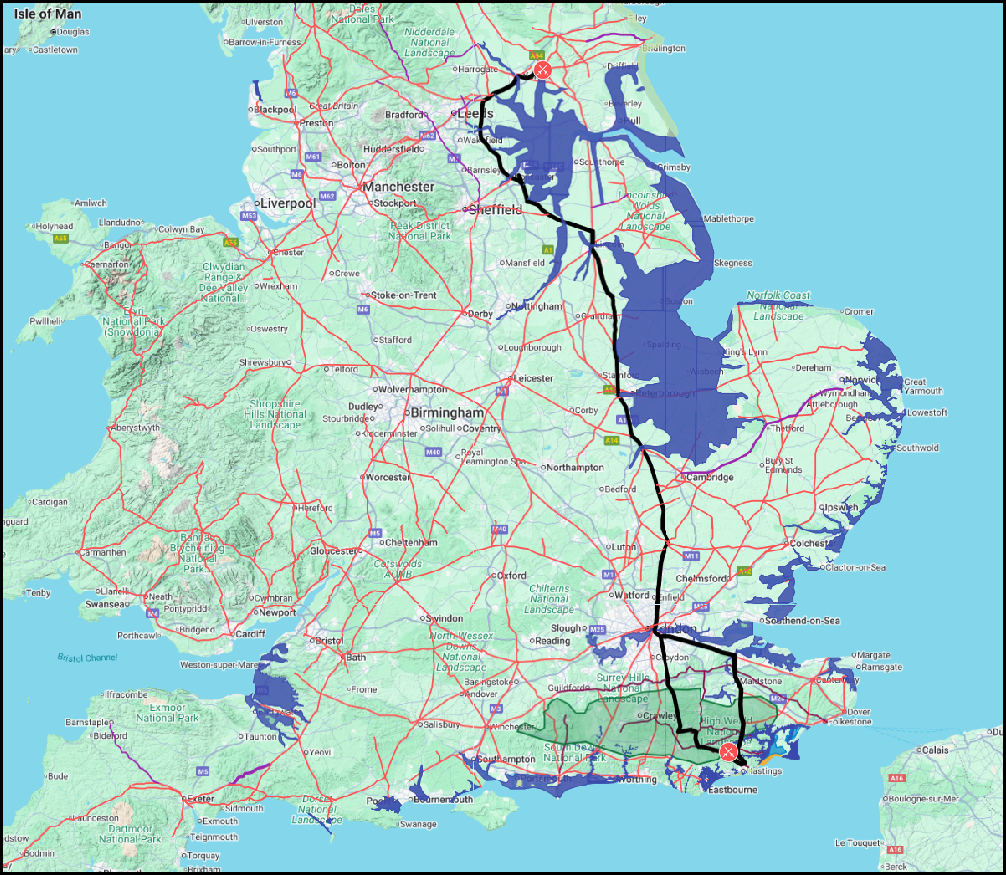
Route of the messenger from Hastings to King Harold in York ▲
This map shows the route a messenger from Hastings a messenger must have taken to reach Harold in York. South of London there are two possibilities, the first takes the Hastings to Gravesend Roman road, the second takes the old ridgeways to Crowborough where it meets the Lewes to London Roman road.
There is not a lot of difference between either route, and the total distance is about 280 miles from Hastings to York.
The map also shows the Roman roads identified by Ivan D Margary together with the high tide level being about 4 metres higher, I haven't included coastal erosion as I do not as yet have the full erosion rates across Britain.
Looking at the old Roman roads, to go from London to Stamford Bridge would entail Harold taking his housecarls from London to Braughing on 'Ermine Street'(M2a) then from Braughing to Chesterton(near Peterborough M2b). Then skirting the Wash(which would have extended to near Peterborough) then through Stamford, Grantham and Ancaster to Lincoln still on Ermine Street(M2c). Here he would have to come off Ermine Street and had to march to Doncaster on the road skirting the Humber Estuary(M28a) After Doncaster he would have followed the 'Roman Ridge' from Doncaster to Tadcaster (M28b) and then to York still avoiding the Humber Estuary on the (M28c). Finally he would need to go towards Heslington and finally to Stamford Bridge to fight the Battle.
Because of the location of the 'Battle of Stamford Bridge' the most logical explanation for the position of the Viking fleet would have been at Driffield which would have been part of the Humber Estuary at the time, then they could march down the old Roman Road from Driffield to Stamford Bridge and hence on to York. As Harold caught them near Stamford Bridge, it would seem likely that they were camped somewhere between their fleet and York.
If we now look at the maximum speeds that troops on foot and horseback can travel, we can work out the timetable of events after the 'Battle of Stamford Bridge'.
Assuming that a messenger had two horses, and could change these at regular intervals on the journey then they could probably have traveled 60 - 70 miles per day.
We also have to assume the messengers traveled on the old main Roman roads across England.
Also if they were to change the horses on a regular basis then there would need to be some form of messenger organisation, or at least a number of known horse changing places on each major road, together with sleeping accommodation for the messengers.
We will take 70 miles per day as our mileage for messengers as a worse case scenario.
Saxon Huscarls and Nobles
We know that the Huscarls were wealthy so probably rode one horse and carried their armour etc on a second horse.
They must have traveled by horse, but fought on foot as their Viking axes couln't be effectively wealded on horseback, as they need space to be swung.
They wouldn't have been as fast as a messenger due to the weight of their weapons and their treasure etc that they would carry, so their probable maximum speed was about 40 miles per day.
Saxon Thegns
The Thegns were required to own a helmet, mail armor, a sword, and a horse.
Although armoured they weren't as wealthy as the Huscarls or Nobles so probably didn't own a second horse
This would mean they couldn't travel as fast, so we will assume a speed of 30 miles per day.
Saxon Fyrð
The Fyrð would have been armed with weapons provided by their local landowner, so depending on their wealth they may have Chainmail corselets or padded leather jerkins, iron or leather helmets and swords.
The poorer or those from a lower castes would be armed with hachets, bills, spears clubs and great picks, iron forks and stakes and most likely a seaxe as backup.
They would have traveled by foot, so were unlikely to move more than 17 - 20 miles a day, we will take the lower figure of 17 miles per day for the calculations.
Baggage or Carts
These would have been unlikely to travel more than about 10 miles per day.
If we now look at the maximum speeds that troops on foot and horseback can travel, we can work out the timetable of events after the 'Battle of Stamford Bridge'. The following chart shows the most likely maximum distances various troops can travel in one day.
Maximum travelling speed in Saxon times using Roman Roads 209 miles to London
Type
Distance per day(miles)
York to London(days)
Messengers
70 miles
3 days
Housecarls
40 miles
6 days
Fyrð
17 miles
13 days
Baggage Train
10 miles
21 days
The return journey would have most likely taken the reverse route as other Roman roads would have not been as quick, this journey is about 209 miles from London to Stamford Bridge and would take about 6 days if they could average 40 miles a day on horseback each with two horses. This would have been fine for the housecarls who were horse mounted, but none of the Fyrð would have been able to keep up this pace, so Harold must have sent word ahead to get the Fyrð to join him near London. The Fyrð may have been able to march 17 miles in a day but those from the north would have taken too long to get to London so the southern Fyrð who would battle at 'Hastings' would have been different troops.
Norman fleet finally sets sail after winds shift, crossing the English Channel.
September 28th (days elapsed 0)
William lands at Pevensey (Sussex) on September 28, unopposed.
The Messenger starts out in the morning from Hastings to travel the 280 miles to York using the Roman roads M13 from Hastings to Rochester, then the M1(Watling Street) to London then the M2(Ermine Street) to Lincoln then the M28 to York.
Assuming 70 miles per day then he would take 4 days so arriving on the morning of the 2nd October.
October 2nd (days elapsed 4)
In the morning Harold learns of William's landing, gathers the Huscarls and sends out messengers to the other counties to meet him in London.
Harold and the Huscarls start to ride to London down the M28 and then M2(Ermine Street) the 211 miles from York via Lincoln to London which at 40 miles per day would take about 5.3 days hence they would arrive late on the 7th.
October 7th (days elapsed 9)
Harold and the Huscarls arrive in London, now he has to wait for the troops from other areas to arrive, and then to travel the 67 miles to Battle.
We now need to calculate when he left London to arrive on the 13th October when his slowest troops the Fyrð only marched 17 miles per day. This means that they need to leave in the morning on the 10th of October to reach Battle by the evening of the 13th.
October 10th (days elapsed 12)
Harold, the Fyrð and the Huscarls leave London by midday or they won't reach Battle by the 14th.
October 11th (days elapsed 13)
Mounted fighters from areas who have arrived late in London leave for Battle but will only take 2 days to reach Battle.
October 13th (days elapsed 15)
Harold's army arrives near Battle and has a party.
Norman scouts spot the English forces and report to William.
October 14, 1066AD
The Battle of Hastings begins at ~9 AM.
What troops could get to Battle to Fight the Normans ▲
Master Wace provided a list of places where he believed troops came from, is this possible based on the speed of various troop types.
The list he provided is as follows: Those of London had come at once, and those of Kent, of Herfort, and of Essesse ; those of Suree and Sussesse, of St. Edmund and Sufoc; of Norwis and Norfoc ; of Cantorbierre and Stanfort ; Bedefort and Hundetone *. The men of Northanton also came ; and those of Eurowic and Bokin keham, of Bed and Notinkeham, Lindesie and Nichole. There came also from the west all who heard the summons ; and very many were to be seen coming from Salebiere and Dorset, from Bat and from Sumerset. Many came too from about Glocestre, and many from Wirecestre, from Wincestre, Hontesire, and Brichesire ; and many more from other counties that we have not named, and cannot indeed recount.
This chart shows when a particular area would receive Harolds troop request by calculating the time from York to the area and dividing it by the messenger speed of 70 miles per day, and applying this to the date Harold received the alert of Williams landing. This gives an approximate date of knowledge of the invasion, then it would take a day to muster the troops before they can leave.
This chart shows how long it will take Huscarls to travel at 40 miles per day from their County/Town firstly to London, then on to Battle the Normans at Hastings. Days to London show the number of days to reach London. Days to Battle means the number of days from their Town/County until they get to Battle. If the cell says impossible then they wouldn't be able to reach Battle until after the Battle.
This chart shows how long it will take Thanes to travel at 30 miles per day from their County/Town firstly to London, then on to Battle the Normans at Hastings. Days to London show the number of days to reach London. Days to Battle means the number of days from their Town/County until they get to Battle. If the cell says impossible then they wouldn't be able to reach Battle until after the Battle.
This chart shows how long it will take the Fyrð to travel at 17 miles per day from their County/Town firstly to London, then on to Battle the Normans at Hastings. Days to London show the number of days to reach London. Days to Battle means the number of days from their Town/County until they get to Battle. If the cell says impossible then they wouldn't be able to reach Battle until after the Battle.
County/Town
News Arrives
Days To London
Arrive
Days To Battle
Arrive
Bedfordshire(Bedford)
04-Oct-66
2.9
08-Oct-66
6.4
12-Oct-66
Berkshire(Thatcham)
05-Oct-66
2.9
09-Oct-66
6.4
12-Oct-66
Buckinghamshire(Buckingham)
04-Oct-66
3.3
09-Oct-66
6.8
12-Oct-66
Cambridgeshire(Cambridge)
04-Oct-66
3.1
08-Oct-66
6.6
12-Oct-66
Cheshire(Chester)
04-Oct-66
10.5
impossible
14.0
impossible
Cornwall(Plymouth)
07-Oct-66
10.7
impossible
14.2
impossible
Derbyshire(Derby)
04-Oct-66
4.5
09-Oct-66
8.0
13-Oct-66
Devon(Exeter)
06-Oct-66
9.9
impossible
13.4
impossible
Dorset(Salisbury)
06-Oct-66
6.3
impossible
9.8
impossible
Essex(Colchester)
05-Oct-66
3.3
09-Oct-66
6.8
13-Oct-66
Gloucestershire(Gloucester)
05-Oct-66
5.1
11-Oct-66
8.6
impossible
Hampshire(Winchester)
05-Oct-66
3.3
10-Oct-66
6.8
13-Oct-66
Herefordshire(Hereford)
05-Oct-66
8.0
impossible
11.5
impossible
Hertfordshire(Hertford)
05-Oct-66
1.5
07-Oct-66
5.0
11-Oct-66
Huntingdonshire(Huntingdon)
04-Oct-66
3.9
09-Oct-66
7.4
12-Oct-66
Kent(Canterbury)
05-Oct-66
3.1
09-Oct-66
6.6
13-Oct-66
Leicestershire(Leicester)
04-Oct-66
5.1
10-Oct-66
8.6
impossible
Lincolnshire(Lincoln)
03-Oct-66
7.9
12-Oct-66
11.4
impossible
Middlesex(London)
05-Oct-66
0.0
06-Oct-66
3.5
10-Oct-66
Norfolk(Norwich)
05-Oct-66
5.9
11-Oct-66
9.4
impossible
Northamptonshire(Northampton)
04-Oct-66
3.4
08-Oct-66
6.9
12-Oct-66
Nottinghamshire(Nottingham)
04-Oct-66
4.4
09-Oct-66
7.9
13-Oct-66
Oxfordshire(Oxford)
05-Oct-66
2.8
09-Oct-66
6.3
12-Oct-66
Rutland(Whitwell)
04-Oct-66
5.6
10-Oct-66
9.1
impossible
Shropshire(Kidderminster)
04-Oct-66
6.4
12-Oct-66
9.9
impossible
Somerset(Bath)
05-Oct-66
5.9
12-Oct-66
9.4
impossible
Staffordshire(Stafford)
04-Oct-66
7.1
12-Oct-66
10.6
impossible
Suffolk(Bury St Edmunds)
05-Oct-66
4.1
10-Oct-66
7.6
13-Oct-66
Surrey(Reigate)
06-Oct-66
1.1
08-Oct-66
4.6
11-Oct-66
Sussex(Chichester)
06-Oct-66
4.0
Coast Route
10-Oct-66
Warwickshire(Warwick)
04-Oct-66
4.7
10-Oct-66
8.2
13-Oct-66
Wiltshire(Salisbury)
06-Oct-66
4.3
11-Oct-66
7.8
impossible
Worcestershire(Worcester)
04-Oct-66
8.3
13-Oct-66
11.8
impossible
Yorkshire(York)
02-Oct-66
10.6
impossible
14.1
impossible
Summary map of Harolds route and the Roman roads used ▲
This map shows a summary of where the troops could manage to arrive from, green horses mean Thanes and Huscarls, purple figures show where the Fyrð could manage to arrive in time to join the Battle of Hastings.
I have included Sussex(Chichester) Fyrð in the list of troops as they are unlikely to have marched to London and back, but just travel across to the muster point which would be nearer to Hastings.
The road to battle — 28 September to 14 October 1066
28 Sep
Day 0
William lands at Pevensey
694 ships beach unopposed. The Norman army begins unloading horses, weapons and prefabricated fort materials.
Norman landing
28 Sep
Day 0
Messenger departs Hastings
A knight observed the landing from behind a hill. He rides north at once — 280 miles to York via Watling Street and Ermine Street, averaging 70 miles per day.
70 miles/day
25 Sep
Day −3
Battle of Stamford Bridge
Harold crushes the Norse invasion. He is at dinner in York celebrating when news of William arrives — a moment recorded by Henry of Huntingdon.
York, 209 miles north
2 Oct
Day 4
Harold receives the warning
The messenger reaches York after four days riding. Harold immediately dispatches fresh riders in every direction — the muster of England begins.
News reaches York
3 Oct
Day 5
First wave — nearest shires warned
Riders branching south down Ermine Street reach the closest counties within a day of Harold receiving the news.
Lincolnshire — 74 miNottinghamshire — 127 miDerbyshire — 128 mi
These shires can muster and still reach Battle by 9–10 Oct
4 Oct
Day 6
Second wave — midland shires warned
Riders fanning east and west reach the broad midland counties. Bedford is 158 miles from York, Norfolk 181, each receiving the summons within two days.
All can get huscarls to Battle by 9–10 Oct if they ride immediately
5 Oct
Day 7
Third wave — southern shires warned
Riders arrive in London and the southern counties. Gloucester is 189 miles from York, Winchester 238. These shires have very little time to muster and ride south.
London — 211 miGloucestershire — 189 miWinchester (Hants) — 238 miKent — 216 miSuffolk — 187 mi
Huscarls from these shires can still reach Battle by 10–12 Oct
6–7 Oct
Day 8–9
Too far — the west cannot answer
Riders finally reach the far south-west. But Devon is 294 miles from York, Cornwall 337. Even riding immediately, their huscarls arrive after the battle is lost.
Devon — arrives 12 OctCornwall — arrives after battleDorset — borderline, 12 Oct
Harold fought at Hastings without the full strength of England
2 Oct
Day 4
Harold and the Huscarls ride south
The mounted Huscarls leave York at once for London — 209 miles at 40 miles per day. They arrive around the 7th and rest several days before marching on.
40 miles/day on horseback
7 Oct
Day 9
Harold arrives in London
The Huscarls reach London and rest while Harold waits for southern contingents to assemble. The southern Fyrd are local men — they do not march from York but muster close to home.
London — 67 miles to Battle
10 Oct
Day 12
The army marches from London
Harold, the Huscarls and the southern Fyrd depart together. The Fyrd are local Sussex and Kent men — fresh, on familiar ground, and fighting to defend their own homes. The Huscarls have rested in London since the 7th.
Fyrd: local southern men
13 Oct
Day 15
Harold's army arrives near Battle
The English force assembles on the Senlac ridge. The Huscarls are rested. The Fyrd are local men who have not made the long march from York. Norman scouts report to William.
Senlac ridge, East Sussex
14 Oct
Day 16
The Battle of Hastings
The battle begins at approximately 9am. After nine hours of fighting Harold is killed. The Norman Conquest of England begins.
For the Saxons recorded by Wace to have reached Hastings by 14th October 1066 the Saxons must have had a very efficient messenger service throughout the country or the warning wouldn't have reached the counties that are a long way from London.
;)

)
)
)
)